I'm not dealing so well with the advent of SNUFF, the 39th (and upcoming) Discworld novel by Terry Pratchett.
If Vimes dies in this book, I'll just go die with him.
Just kidding. But honestly. I cried for two days straight when I found out Severus Snape died, and I hadn't even read the book yet. When Inspector Morse died I couldn't even read the book (it's still just sitting there in my library). And now to have Samuel Vimes shuffle off the face of the Disc? I can't handle it. The Watch were my best friends during my saddest and most awkward years, because there was a little part of me in each of them (or is it the other way around?).
I LOVE Samuel Vimes and he's one of the few characters who have never, ever, ever disappointed me. When a new Watch book comes out I just go uunggggh! and have to get it LIKE NOW (ie have it shipped from the States because it takes the Pratchett books a long time to get here). Personally I'm not a huge fan of most of the other Discworld subseries, like the Tiffany Aching stories and the Rincewind books, and it's been breaking my heart that the Watch books have been so few and far between. (Though, yes well, I did enjoy the Moist von Lipwig books very very much and they were a nice break, but I probably enjoyed them best because they were still set in Ankh Morpork and Vimes and Vetinari still play a role).
Probably I'm overthinking. But the cover has just been released, and see that little hourglass there on the boat with him? Sometimes an hourglass is just an hourglass, but sometimes an hourglass is something Death (or his apprentice, Mort) carries around with him to see how much longer a poor bugger has left.
Sam Vimes, if you can hear me all the way there in Ankh-Morpork... please don't die.
I was rereading Mansfield Park, my third favorite Austen novel. Well, really, I still feel the need to punch Edmund in the nose sometimes--how like a man, to recognize a woman's real, material, moral imperfections at first but then to fall so much under her charm that his own judgment was compromised and it took adultery and a family crisis to make him see the truth--but this exchange caught my eye. I am not sure how Jane Austen truly felt about the clergy; her father was a rector, which might point either way, and in her books she paints such different portraits of them (as Lizzie of Pride and Prejudice said) "as to puzzle me exceedingly". But I hope she meant something of what she says through Edmund's character in this small exchange between Edmund Bertram and Mary Crawford.
"So you are to be a clergyman, Mr. Bertram. This is rather a surprise to me."
"Why should it surprise you? You must suppose me designed for some profession, and might perceive that I am neither a lawyer, nor a soldier, nor a sailor."
"Very true; but, in short, it had not occurred to me. And you know there is generally an uncle or a grandfather to leave a fortune to the second son."
"A very praiseworthy practice," said Edmund, "but not quite universal. I am one of the exceptions, and being one, must do something for myself."
"But why are you to be a clergyman? I thought that was always the lot of the youngest, where there were many to chuse before him."
"Do you think the church itself never chosen, then?"
"Never is a black word. But yes, in the never of conversation, which means not very often, I do think it. For what is to be done in the church? Men love to distinguish themselves, and in either of the other lines distinction may be gained, but not in the church. A clergyman is nothing."
"The nothing of conversation has its gradations, I hope, as well as the never. A clergyman cannot be high in state or fashion. He must not head mobs, or set the ton in dress. But I cannot call that situation nothing which has the charge of all that is of the first importance to mankind, individually or collectively considered, temporally and eternally, which has the guardianship of religion and morals, and consequently of the manners which result from their influence. No one here can call the office nothing."
My favorite part--the only important part, really; I just wanted to contextualize--was the last paragraph. What do you consider important in life? Grades? Fine, that's important; family? I would be crazy to deny its importance, too. But there is something that comes far and away above these things; the thing that is of most importance, and therefore the thing that should occupy the most of your mind, your heart, your soul, your strength. And funnily enough, to most of the world, this essential thing, this one necessary thing, is "nothing."
What is the value of the things you are doing? If you don't direct them properly, the trans you're reading, the exam you're taking, the five years you spend in med school and all the years beyond--each action, whether small and insignificant or of serious moment--can end up being worthless when you die. The things you amass on earth, they say, you cannot take with you. But if you amass struggle, and good intentions, and a sincere desire for the good--sincerity being self-knowledge and the humility of knowing that no, you are not the best judge of things and there is a God whose intellect is greater than yours, you tiny insignificant human--these are things you can take with you when you die.
The Little Prince said that all that is essential is invisible to the eye; to that I say, maybe it's more correct to assert that: all that is essential is eternal. All other things pass away. As John Donne wrote,
All other things to their destruction draw, Only our love hath no decay ; This no to-morrow hath, nor yesterday. Sometimes I want to shake my friends and bemoan that I am surrounded by Mary Crawfords, who see things humanly and shallowly (not that I can't outstrip others in shallowness sometimes). Yesterday I went to the wake of someone I never saw before she died; we stood in front of her coffin in the oratory and we said the responsory for the dead as we came in. And even though I had never known her before, I know that I know the essentials: that she was loved, and that she had struggled, and that she will soon be in heaven, if she is not there now.
Where your treasure is, there also will your heart be. Are you putting your heart and your treasure into things that will never last? Or are you looking toward eternity?
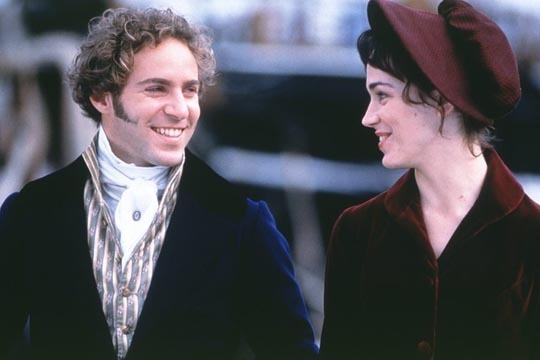
I found out that my review (written in 2008) for "Gaudy Night", the BBC adaptation of the book of the same novel by Dorothy L. Sayers, has been linked and featured on the Edward Petherbridge website! Granted, they cut out the mean parts I wrote about how terrible the series itself was, but I feel, irrationally, somewhat closer to one of my idols. Edward Petherbridge played Lord Peter Wimsey to Harriet Walter's Harriet Vane, and I believe that he is the best Lord Peter that there ever was. Since I don't want to link to my livejournal here, I thought I'd just repost the entire review (edited and cut a bit for length).
A post, finally, about one of the most realistic romances I’ve ever come across. I’ve just finished watching the BBC’s Lord Peter-Harriet vane series. I suppose, in the light of what a crashing disappointment the “Gaudy Night” series was, that it’s unfortunate that I’ve just finished rereading the book on which it was based. I’ve been going on a series of long trips lately and Dorothy L. Sayers is a good companion for long bus rides. Prior to Gaudy Night I’ve also just reread Strong Poison, Busman’s Honeymoon and Have His Carcase, and before these I finally finished that thumping good book, Murder Must Advertise. My dad came home from Hong Kong some days ago and he brought with him a set of DVDs that I’d requested but didn’t expect to have for quite some time—the three miniseries that feature Edward Petherbridge and Harriet Walter as Lord Peter and Harriet Vane, respectively.
I suppose I should say that I never do expect much from adaptations of, well, anything. Hence my gratified amazement at having all of my expectations for the 1980s Brideshead Revisited adaptations so wonderfully surpassed. So I was also surprised to find that Have His Carcase was so pleasing, in terms of how faithful it was to the original. Some well-written exchanges were skipped or trimmed, and Harriet seems to be altogether too happy to be with Lord Peter rather than simultaneously friendly but irritable and cautious (lest he get too close), but overall I like the camaraderie between Edward Petherbridge and Harriet Walter, and Richard Morant as Bunter, while unexpected, really very definitely has his own charm. (He’s unfairly and most cruelly handsome.) (It was also a small treat to have Brideshead’s Boy Mulcaster as the singularly disgusting Henry Weldon.)
And I take back everything I ever said about Edward Petherbridge. He is so very attractive, and than thin, sensitive mouth—that forehead—those shoulders are all Lord Peter’s. I suppose it’s irrational that in my mind, Lord Peter is very much younger—he is supposed to be in his forties or thereabouts at the time of the Wimsey-Vane arc—and Edward Petherbridge brings to the character a mix of playfulness and self-deprecating dignity, with just a dash of snobbishness and a whole lot of humor, with just the right age, that I find myself reevaluating the picture of Peter I’ve made in my mind.
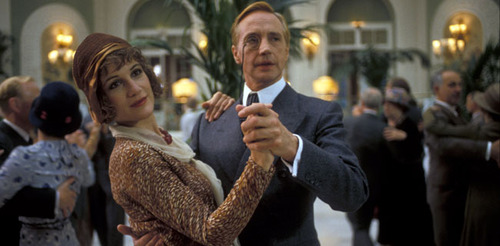
I have nothing to say about Gaudy Night except that it was a horrible disappointment. Am I to blame Philip Broadley and wish that Rosemary Ann Sisson had instead undertaken the dramatization? Gaudy Night was a waste of 150 minutes, or would have been at least, were it not for the scene (not found in the book) of Lord Peter and Harriet dancing, and he smiling. There is something so unexpectedly attractive about Lord Peter when he smiles. He does look as though he is in love with her, and where in Have His Carcase he was admiring and attentive, in Gaudy Night there was a longing, a wistfulness in how he held Harriet and looked at her that was probably the only thing that was faithful to the book. Gaudy Night might not be much of a detective novel but every dialogue, every quotation and every exchange was so well thought out and so laboriously written that Philip Broadley and company might have done so much better than to cut out the important parts and replace it with ones that were not only inconsistent with the rest of the book, but that were very unnecessary as well. What was the point of inserting Miss Cattermole and Miss Flaxman if they weren’t going to bring anything to the plot? And why cut out Saint-George? (Couldn’t they find anyone attractive enough?)
I shouldn’t have expected so much, but I am bitterly disappointed, “Have His Carcase” notwithstanding. There is so much about Gaudy Night that makes it a very complicated book, with the tension between Harriet and Peter at its “verberant core.” Her fears about giving in, and her fear of being dependent on another person for her happiness; Peter bitter and at the same time more accepting, more mature. That moment on the river when Harriet realizes, or accepts, that it has finally happened, that she does love him now. That sonnet, and how Peter had written and meant
Lay on thy whips, O Love, that we upright, Poised on the perilous point, in no lax bed May sleep, as tension at the verberant core Of music sleeps; for, if thou spare to smite, Staggering, we stoop, stooping, fall dumb and dead, And, dying, so, sleep our sweet sleep no more.
I don’t mind that certain very good books don’t get made into TV or film adaptations. After all, books were written to be enjoyed as books, and if the adaptation turns out to be good or approaching better, then it’s merely incidental. But I would have liked it so much better if Gaudy Night had never been made. It was—to use an all-too-appropriate term—sacrilege.
The Secret Garden is one of my favorite books. I can't really explain why I was attracted, from page one, to Mary Lennox, irritable and knowitallish and (as the song goes) really, really quite contrary. I saw myself in her I suppose. When I was little there used to be a Japanese cartoon on ABS-CBN--it was dubbed into Filipino and had the title of Maria at ang Lihim na Hardin--and that was where I met her first; but there isn't really any kind of substitute for reading Mary Lennox on the page, or seeing Kate Maberley (see photo) play her in the most faithful (at least in spirit) adaptation of The Secret Garden ever made.
Look at her! I love her here, irritable in hot weather and dressed in more skirts than she can play around in. This is Mary with Dickon and Colin. I loved the unquestioning loyalty of the other two--how they took her, temperament and all, and loved her. I loved how Dickon was with the two of them, easily the poorest and most uneducated, but the wisest, simply because he was the most loved.
This is Mary and Colin. I suppose at the time it was legal to marry your first cousin; I loved the two of them together so much that I didn't particularly care as a child.
When I first read the book, I was charmed by the characters--how uniquely flawed they all were, how miserable, how much drawn into themselves, and how Mary's being catapulted into a life in Misselthwaite manor drew them out--and the tiny details about flowers and gardening, about taking care of things, about building things from scratch and caring for them and loving them. When I grew older and watched the movie (one of my family's favorites; we've memorized the script) and read the book over and over again, I realized that Mary, Colin and Archibald Craven are all like the garden... neglected, and in need of love and sunlight.
There is no real point to this blog. Tonight, the night before my pulmo OSCE, I just kept listening to this song, Lily's Eyes, which is the only song I know from the musical version of the Secret Garden:
The Snape/Lily parallels notwithstanding (eww), I really love this song. It gets better when you think that so much misery is made better when Mary comes along, an unknowing knight errant, sent by God to save the inhabitants of Misselthwaite from dwindling into despair.
The thing is, we can all dwindle into despair if we want--we can all let our spirits become neglected gardens. The movie is so atmospheric, so much rural England (it sounds like Scotland but the original inspiration is English) in the winter, so much snow and dark hallways and walled-in gardens. It fills you with a sort of claustrophobia, and fear, and a sense of despair. What I'm trying to say, in my own feeble distracted-medical-student way, is that everyone has that kind of garden inside us--in hibernation, as though it were winter, snowed under with memories and grudges, and attachment. Archibald Craven had grown too much attached to his wife that he couldn't see that his son and his niece were right in front of him, starving for affection and approval; like a garden in dire need of pruning, Misselthwaite was left to be strangled (as by overgrown branches) by the memory of Lily, Archibald's wife. (In the musical it takes a more sinister turn--Colin's doctor and Archibald's brother was in love with her, too.). We can let ourselves become like that. It's easy. You can exist without living--letting one day after another go by, going through the motions, growing comfortable, never giving yourself entirely.
Or you can choose to embark on the new adventure of falling in love. With life; with your family; with the God who demands but who gives back a hundredfold. And the beauty of a blossoming soul is a thousand times more beautiful than any garden that could grow under Dickon's expert hands.
I've just finished Dava Sobel's book, Galileo's aughter.
The book is just so much better than I ever expected--now it's my favorite nonfiction book, in a tie with St Therese of Lisieux's Story of a Soul. I want my own copy. I just stumbled upon this one when Carmela, one of my friends who used to stay in Manila a few years ago but who got reassigned to Cebu, was in our center for a day, during Pentecost. She wanted me to pass the book on to Tina, who had lent her the book a long time ago, but I saw the cover and the summary and couldn't put it down. I'm usually not very interested in Italian history, and even less interested in the dealings of "great men" like Galileo. But the moment that I read that the daughter in question was a nun in a convent--was in fact a "Poor Clare" after the spirit of St. Francis and the rule of St. Clare--I guess I started to think that there was so much more to a man like him than I thought.
In my head Galileo was this man who thumbed his nose at the Church (though I admit that the Inquisition at the time had made a very great mistake); the book made me realize that this wasn't what happened at all.
Galileo was a faithful Catholic his whole life--before, during, and after his trial. Descriptions of pilgrimages he made to Loreto for the sake of his health, showing his great devotion to Our Lady, made me smile; seeing how he had to ask to be allowed to wander out for Mass during Easter in Florence, while he was still under house arrest, made me shake my head in shame. The mundane details revealed by his daughter's letters to him--the collars he sent to be starched and the citrus fruits he sent to be candied, and the presents and trinkets he sent along to his daughter, Suor Maria Celeste--made me fall in love with the story even more; it almost feels like someone made this all up, as though the story is too rich and beautiful to be true.
In the end I know more about Galileo's brilliance than I ever wanted to know--the man seemed to run on curiosity, and seemed to want to study every possible subject under the sun (except comets), and he made valuable contributions to so many new sciences--but what sticks with me the most is the impression I have of him as a sweet, loving Father, at least to Suor Maria Celeste; the other daughter is obscured by the lack of any surviving letters or references about her. He might have been an intellectual giant, but like all men he was immersed in the details of daily living--the plants in the garden, his own bodily illnesses, the search for a partridge to send to his daughter for the sake of a sick nun, the expenses of his oldest son.
I think of old, blind Galileo in those last few years at Arcetri, working and talking to his new companion Vincenzio Viviani and perhaps to Evangelista Torricelli, all the while missing his eldest daughter with a constancy like the pumping of blood, like heartbeats. I don't think I would have been far off the mark. But it's sweeter to think of him as he was, when he was still allowed to wander outside the house and to walk the short distance between his house at Arcetri and the convent of San Mateo, where his daughter sat waiting for a visit while mending an apron or tending to the sick.